
Dynasty Rookie Draft Pick Values: A Slot-by-Slot Guide
Dynasty rookie draft pick values fall steeply at the top and flatten out at the bottom. The 2027 1.01 is worth 7,500 points while a late first sits near 3,876, and the steepest drop on the board comes right after the 1.12. Future firsts lose about 15% of value for each year they sit in the future.
The 2027 Value Curve, Slot by Slot
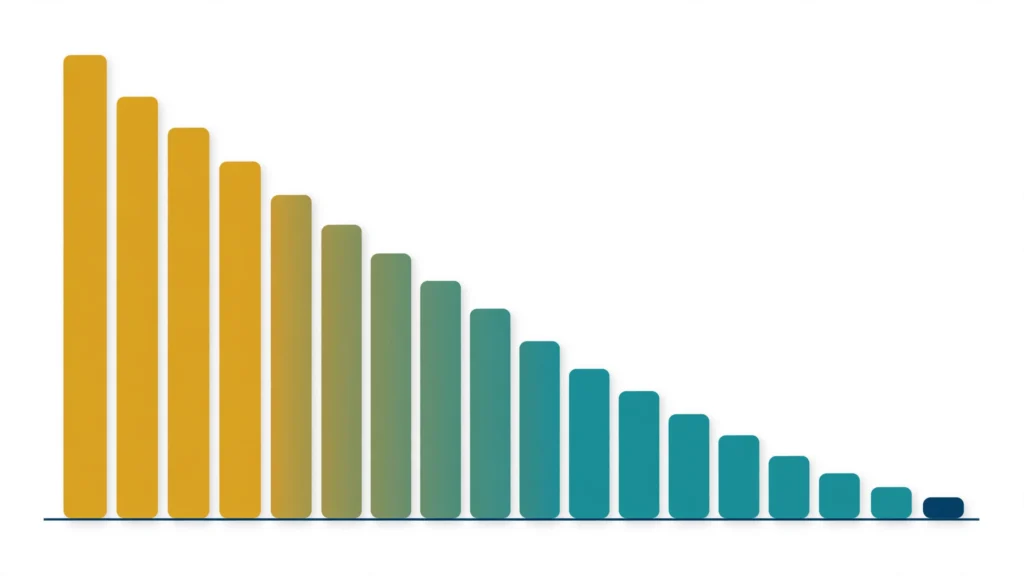
Every rookie draft pick has a price, and those prices do not fall in a straight line. Let us walk the 2027 curve on the Dynasty Pick Value Chart, from the top of the first round down to the last pick of the third.
The 1.01 is worth 7,500 points. The 1.02 drops to 7,063. The 1.03 sits at 6,652. So the first three picks cost you roughly 450 to 850 points per step down. That is real money at the top of the board.
The middle of the first round keeps sliding: 1.04 at 6,265, 1.05 at 5,900, 1.06 at 5,556, 1.07 at 5,233. The 1.08 is 4,928, the 1.09 is 4,641, the 1.10 is 4,371, and the 1.11 is 4,116. By the 1.12 you are down to 3,876, barely half of what the 1.01 costs.
Then comes the cliff. An early second-round pick is worth 2,072 points. That is a 1,804-point fall from the 1.12 to the next pick on the board, the steepest single drop anywhere. A mid second is 1,630, a late second is 1,282. Thirds barely move the needle: an early third is 612, a mid third is 482, and a late third is 379.
The shape tells the whole story. The top of the draft is a mountain, the back half of the first round is a hill, and by the third round the curve is nearly flat. Once you see the numbers, you stop treating picks as interchangeable.
Tier Breaks: Where the Curve Actually Bends
A value curve is only useful if you know where it bends. The bends are the tier breaks, and they are where smart trades happen.
Tier one is picks 1.01 through 1.03. These are the elite slots, worth 6,652 to 7,500 points. The gap between the 1.03 and the 1.04 (387 points) is small, but the names attached to the top three picks usually justify the premium.
Tier two runs from the 1.04 to the 1.06, worth 5,556 to 6,265. These are still first-round difference-makers, but the price has cooled. Tier three covers the 1.07 through 1.09 (4,641 to 5,233), and tier four is the 1.10 through 1.12 (3,876 to 4,371).
Then the first cliff, and it is a big one: everything after the 1.12. Seconds live in their own world at 1,282 to 2,072, and thirds are dart throws at 379 to 612. The bend between the 1.12 and an early second is the most important line on the board. A deal that crosses it needs real value coming back, not just extra picks.
How Values Move Through the NFL Draft Cycle
Pick values are not frozen. They breathe with the NFL calendar, and the pattern repeats every year.
In the fall, picks are quiet. Nobody knows the draft order yet, the rookie class is a rumor, and managers are busy winning games. This is when picks are cheapest. If you want to buy future capital, buy it while everyone is looking at their starting lineup.
As the NFL season ends and the draft order locks in, values start to climb. The NFL Scouting Combine in February adds fuel, and pro days in March add more. By the time the NFL Draft arrives in April, the hype is at full volume, and rookie pick values peak right before your own rookie draft.
The lesson is simple: picks cost less in November and more in May. That is the market, and you can trade with it instead of against it. For the full timing playbook, including when to sell the hype, see the guide on how to trade dynasty draft picks.
Trading Up: What It Really Costs
Moving up in a rookie draft always costs more than the math says it should. The chart shows you why: the slots above you are priced higher per step, and the seller knows it.
Here is how it plays out on the live chart. Say you hold the 1.09 (4,641) and you want the 1.04 (6,265) to grab a player sliding into the top tier. You offer your 1.09 plus an early second (2,072). That is 6,713 points of value for a 6,265-point pick.
The math says you overpaid by 448 points. The market says that is the cost of moving up five slots into a better tier. Small overpays to cross a tier break are normal. Big overpays to move within the same tier are not. Check the bend first, then decide if the jump is worth the tax. If you want a deeper breakdown of package deals, the dynasty trade-up package deal guide covers the mechanics.
Trading Back: What You Gain for Sliding
Trading back is the mirror image, and it is where patient managers get paid. When someone wants your slot, they pay the tax. You collect it.
Take the same chart. You hold the 1.05 (5,900). A league mate has his eye on it and offers his 1.08 (4,928) plus a mid second (1,630). That package is worth 6,558 points. You slide back three slots and pocket 658 points of extra value.
The key question is whether the players you like will survive the slide. If your tier has four names you love and you are moving from 1.05 to 1.08, you are getting paid to take the same player. If only one name is left in your tier, the slide is a trap. Tiers decide, not slots.
Future-Year Picks and the 15% Discount
A 2027 first and a 2028 first are not the same asset, even if both end up in the same slot. The chart prices the waiting time, and the discount is steady.
An early 2028 first is worth 6,004 points. An early 2029 first is 5,103. An early 2030 first is 4,338. Each year further out shaves off about 15% of the value. A 2028 late first (3,715) costs less than a 2027 late first (3,876), and a 2029 late first (3,158) costs less still.
This matters most in two spots. First, when you trade for a future first, pay the discounted price, not the current-year price. Second, when you sell a future first, remember the buyer is buying uncertainty. A future first from a strong team should be priced as a late pick in its year, not as a mystery box worth a mid first today. The chart’s year-by-year rows make this easy to check, and the guide to reading the trade value chart walks through the rows in detail.
Three Mistakes That Waste Pick Value
Treating every first as equal. A 1.02 and a 1.11 are both “a first,” and they are 2,947 points apart. Every time you value a pick by its round instead of its slot, you are giving away or overpaying by thousands of points. Price the slot, not the round.
Paying the 1.01 premium in a flat class. The 1.01 costs 7,500 because the top prospect is supposed to be special. Some years the class has no clear standout, and the gap between the 1.01 and the 1.04 shrinks in real drafts. When the class is flat, buy the 1.04 at 6,265 and let someone else pay for the 1.01 nameplate.
Selling a future first at its floor. A future first from a contender is the cheapest first on the market. If you must move one, sell it when the season is young and the team’s record is still a guess, not after a 6-1 start locks it into the late range. Timing is part of the price.
FAQ
How much is the 1.01 worth in a dynasty rookie draft?
On the current chart, the 2027 1.01 is worth 7,500 points, the highest value of any rookie pick. For context, that is nearly double the 1.12 at 3,876, and it outranks every second and third-round pick by a wide margin. In Superflex and tight-end premium leagues, early picks carry even more weight because quarterbacks and tight ends push demand upward. The Superflex trade calculator guide explains how format shifts pick demand.
What is the difference in value between an early first and a late first?
A big one. The 2027 1.02 is worth 7,063 points while the 1.12 is worth 3,876, a gap of 3,187 points. That gap is larger than an entire early second-round pick. Never accept “a first for a first” without checking which slots are involved.
When do rookie pick values peak during the offseason?
Right before your rookie draft. Values climb through the NFL Scouting Combine, pro days, and the NFL Draft in April, then peak in May when rookie fever is highest. They are cheapest in the fall, when managers are focused on winning weekly matchups instead of next year’s class.
How much should I pay to trade up in my rookie draft?
Expect to pay a small premium over the chart math, especially when crossing a tier break. As a rule of thumb, moving up within the same tier should cost close to even value, while jumping into a higher tier costs a 5 to 10% tax. Run both sides through a dynasty trade calculator before you send the offer.
How much is a future first-round pick worth compared to a current one?
About 15% less per year out, on average. An early 2028 first (6,004) costs roughly 15% less than the equivalent 2027 slot would, and an early 2029 first (5,103) costs another 15% less than that. Always price the year, the likely slot range, and the discount together. The buy-low and sell-high guide has more on timing these moves.
Price the Slot, Not the Round
The whole guide comes down to one habit. Stop saying “a first” and start saying “the 1.06.” The chart gives you the number for every slot, the tier breaks tell you where the jumps are, and the calendar tells you when to buy and sell. Check the Dynasty Pick Value Chart before every offer, run the deal through the trade calculator, and let the slots do the talking.
Leave a Reply